Multiple Recorders

I’ve been asked to provide 6 individual isolated tracks for a job next week, and the most either of my recorders do is 4.  I gave production the option of hiring a lovely Sound Devices 788T but they weren’t too keen on the cost.

So, here’s what I’ve made:


I’ve also found that the Edirol R-44 does have Word Clock over the CTRL Sync jack- if you plug it in to the Tascam HD-P2 they’ll sync.

If we’ve also got all the correct cables these also will be synched up to a Nagra VI run by a second recordist- 12 channels, voila!

The mixer’s mainly there so I can monitor both recorders at once

I ran them for 30mins with a mic attached to the mixer (going into both recorders) and didn’t see any deviation of file lengths (although the start/stop times were slightly different)

Posted in Equipment, experiments | Leave a comment

Battery Powered playback

It can be a bit difficult to find commercially available speakers which work off DC or batteries, in fact the only one I know of is the Remote Audio Speakeasy, which isn’t easy to get hold of over here, or cheap.

I normally use a dB technologies L80 if I need to use a speaker, although it’s mains powered only- it’s a 35W amp driving 4ohm speakers and loud enough for most situations. Having taken a look inside, the main transformer outputs 23V, and I’d have to use regulators to get that from my battery power.

After a bit of a rummage around drawers I remembered I had a board for a 25W Tripath 2020 Class-D amp (you can get these off ebay for about £20, and they’re rather good) which ran off 12V.

I’ve got a little Yamaha NS10MM centre speaker, which I normally use as a ‘Grot Box’ monitor which I bought from Hard-Off  (yes, it’s called that, and it’s brilliant) in Japan for about £12 (it still has the label).

I soldered together a few connectors, hooked them up to a 12V Li-Ion pack (another cheapo ebay job) and, as I didn’t have a suitable case for the amp, and the speaker is likely to get chipped, put it all in a camera bag:

I also found out my passive DI works backwards, so can send balanced line out to this or hook up a wireless receiver to the bag

Posted in Equipment | Leave a comment

What’s in my bag

Here’s my bag- every sound recordist’s is a bit different and I thought I’d give you a tour:

Mixer

Logically, I’ll start in the middle.  The mixer’s essentially the ‘heart’ of a sound recordist’s kit- with it the recordist can control the level of signals, so that a healthy signal to noise can be maintained but the signal is not distorted.  It also has analogue limiters which will compress the signal during peaks (such as shouting)- this is one of the main differences between mixers built for broadcast and those built for music (in addition to build, powering options and outputs)

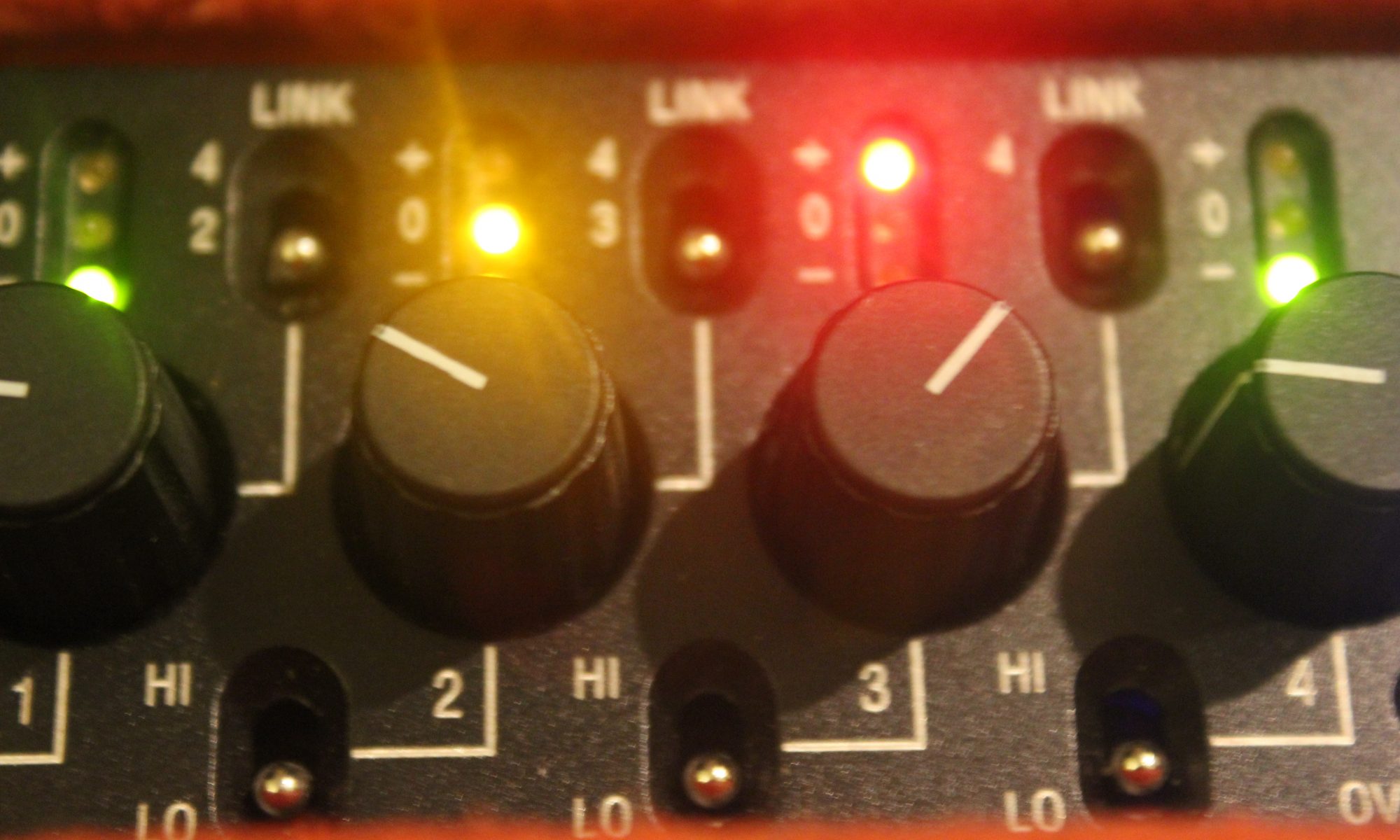
Each of the three larger knobs control the level of each signal being sent to the mix, whilst the gain knobs set how much each signal is amplified.  LF cut is a filter which reduces the amount of lower frequencies present in the signal (which can be increased by microphones being placed close to the subject), this can also cut out some noise from the microphone being moved around and wind noise.

It will also power microphones and amplify their signals

Mixer ‘input side’:

Here’s a view from the left hand side of the bag.  Here the inputs are going into the mixer on the left.  The cable at the top goes to the boom microphone, whilst the cables with red and green bands come from a radio microphone receiver.  The thinner red cables provide power and the black cable going into the recorder on the right comes from the mixer’s digital output

Mixer ‘output side’

This particular mixer (Sonosax SX-M32) has ‘direct outputs’, which means each of the amplified microphone signals can be sent out before they are mixed.  This can give post production more options. Here the top cable, with the darker red ring sends a mix to the recorder and the other three send pre-fader direct outputs. The smaller ‘mono out’ usually goes to a radio transmitter, sending out a 1 channel mix.  There are also a couple of other connectors out of view which include one for a sending a 2 channels to a camera and receiving one back so that I can hear what is being recorded to camera, when not using a separate recorder, and a smaller one which sends the mix digitally to the recorder.

Recorder

This is the box at the bottom of the main picture.  Although it is also possible to plug microphones directly into this particular model, the quality and flexibility is not as good as using a separate mixer (there are a few recorders becoming available which can also operate as a mixer).  This one (Edirol R-44) can record 4 channels of audio, as digital .wav files.   Some recorders also have timecode generators which can be synchronised with cameras, making it faster to synchronise video and audio in post production. I also own a 2 channel recorder with timecode facility

Wireless

There are a number of situations where it is impossible, or extremely difficult to capture quality audio without using cables.   Although the most expensive and advanced wireless systems are not as high quality or reliable as a cable, they’re close- and allow microphones to be placed where they couldn’t without wires.

This particular box (Wisycom MCR42) actually has 4 receivers inside, 2 per transmiter- selecting the one with the strongest signal.  It also has emulation modes for other brands of receiver (Sennheiser and Audio Limited) and a very wide bandwidth, making it suitable for international use

Radios can also be used for sending signals, such as an feed to a director, boom operator, script supervisor or camera to aid with sync (or to send a timecode signal).  There’s also a transmitter for this purpose on the right and second receiver on the left (single channel) for a third radio mic.

Powering

Inside the pocket at the back of the bag is the battery and distributor

From here the battery power is split between the mixer, recorder and 2 channel radio  receiver.  Here is the whole bag opened up:

Here you can see the red cables running to the recorder, mixer and radio receiver in the front pouch

Posted in Equipment | Leave a comment

Computers for Production Recording

In almost all production recording systems some kind of field recorder is used.  In most of these cases they’re actually a very specialised computer running a cut down operating system (usually a Linux kernel or Windows Embedded variant) with custom software.

For example, I’ve found my Tascam HD-P2 runs Windows CE (it’s mentioned in the version 1.05 release notes).  As a you start to think *OMFG my recorder will BSOD on me*, a lot of the problems with Windows (and other OS) is when things get changed, and systems have to deal with this.  Usually with embedded systems this isn’t the case, they’re ‘sealed units’ and run all sorts of systems which cannot tolerate failure like aircraft autopilot systems and industrial automation systems.

Why not run a specialised computer for recording purposes? It’ll be much cheaper, right?

One of the main issues is software.  Although there are quite a few programs for multichannel audio recording and mixing, most do a lot of things you don’t need for production recording (which means more to go wrong) and some don’t do some things you do need (metadata editing and Time Code input).

The best course of action would be to use a piece of software designed for this purpose, AFAIK there are three (prices include VAT):

Boom Recorder (Mac OSX only) £175
Metacorder (Mac OSX only) £1314
SADiE MTR (Windows only, with SADiE Hardware) £4100 with LRX2

You also need an interface to get the audio into the computer.  Here’s a list of those which I’ve found which have at least 8 inputs and a DSP routing system, can be powered by DC in the field

Interface Price Weight (kg) Dimensions (mm) Power Consumption (W)
RME FF UC (USB) 722.73 1.5 218x44x155 13
RME FF UCX (USB/FW) 958.26 1.5 218x44x155 13
MOTU Traveler mk3 (FW) 589 1.73 375x44x229 ?
Metric Halo 2882 (FW) 1215 2 343x44x279 8
Sadie LRX2 (USB) 4100 6 330x65x423 50

Now you’ll need a computer to run it.  I initially had ideas of very small industrial machines with no moving parts and Atom/AMD Fusion CPUs.  These would work fine with the SADiE system (in face any machine with a hard drive fast enough should, as the LRX does the heavy lifting), but I’m not too sure about running OSX on them.  In addition to this the RME USB interfaces don’t work too well with Atom machines (and haven’t been tested with the AMD chips).

Having a look round for a small computer which will run off DC power, not have an atom processor and run OSX it looks like you’re looking at a Mac or a going for a ‘hackintosh’ job (installing OSX on an non-apple x86 machine) on a similarly sized ‘ultrabook’ (which would cost around the same for the base machine).  Prices are given with 15% discount (either as a refurb or through a number of discount schemes, education etc). I’ve discounted the low end Macbook air as I don’t think 2GB memory will cut it:

Computer Price (£) Battery life (Whr) Power consumption (W) Weight (kg)
Display off Display on
Macbook Air 11” i5 4GB 128GB 850 35 4.2 9 1.06
Macbook Air 11” i7 4GB 128GB 970 35 4.2 9 1.06
Macbook Pro 13” i7 128GB SSD 1172 63.5 7.2 12.7 2

Another thing which will need to be added to the system is a TCXO clock, if time code sync is required (clock on LRX2 will probably suffice).  Here are some options:

Denecke SB3 £384
Timecode Buddy Master £810.00
Ambient ACL203 £690

In order to use firewire interfaces with the Macbook air, you need some kind of thunderbolt adapter.  The cheapest current method is (this means it’s actually cheaper to use an RME FF UC with Macbook Air):

Sonnet thunderbolt to expresscard 123.60
Thunderbolt cable 39
Expresscard to FW 16.78


In order to create mixes you’ll also need some kind of mixer or control surface.  If you’re already running a mixer in front of your recorder you can probably make do.  For drama/ cart based setups the only option I can see which runs from DC power is the Avid Artist Mix (formerly Euphonix MC mix) at £1000.  On the other end of the scale there are a few USB powered things with knobs/faders on from Korg and Akai, which may break from just looking at them

Control Surface  Cost (£) Weight (kg) Dimensions (mm)
Avid / Euphonix Artist Mix 1000 2.2 238x30x420
Mackie MCU Pro 1000 7.6 419x119x423


Bag setups *may* be feasible by putting the laptop at the bottom of the bag, the interface where the recorder would normally be and using a small touchscreen monitor for control: eg Lilliput 669GL

Finally here’s a few example packages you could put together here  The LRX2 price is taking into account using an existing laptop, adding the 16mic pre card and 25% discount for part ex with old SADiE kit (can be found on ebay for buttons):

Price Weight (kg) Power Consumption (W)
Cheap (MBA+FFUC+Monitor+Denecke+BR) 2287.73 2.56 17.2
Drama (MBAi7+FFUCX+Avid+Denecke+BR) 3487.26 4.76 17.2
Lo Power (MBAi7+MH2882+Denecke+BR) 2941.03 3.06 12.2
SADiE LRX2 (USB) 4500 8 50
Sound Devices 788T + CL9 6953 3.8 16


Here’s a comparison of different systems taking into account cost, weight and power consumption.  I haven’t added the monitor power consumption- it’s around 8W, assuming you may also use one with a  788T system. I believe the LRX2 can actually display sync video on screen.  I also don’t know the power consumption of the Avid Artist mix

Posted in Uncategorized | Leave a comment

Last Christmas Variations

Here’s something I made the other day after getting a bit distracted while fixing up a slightly faulty Yamaha SHS10 keytar.  It’s all done with by playing the demo (Last Christmas by Wham!) and making different connections on the circuit board

I’ve been told that Stewart Walden’s (now Keith) Cucumber Sandwich is played on a Casio SA10, and features ‘Wake Me Up, Before you Go-Go’

If anyone else knows of any other keyboards featuring George Michael’s work, please enlighten me


Posted in experiments, Recordings | Leave a comment

Voltmeter

I’ve just made a new addition to my self-made power distribution system- a small voltmeter (the display with the numbers on the left, by the recorder).  This allows me to see exactly how much battery power I have left  They’re available from a number of sellers in China on ebay

I just soldered the red and green wires (+ power and voltage reading point) to the positive pin and black to 0V) on my power distribution box and it all works

Here’s the distribution box and battery:

It’s essentially a load of locking DC connectors wired in parallel


Posted in Equipment | Leave a comment

Selling Stuff

I’ve had a rummage through the cupboards and I’m looking to get rid of a few bits I rarely use, or have meant to get fixed and haven’t.  Open to offers on all

Doepfer Regelwerk Discontinued MIDI/CV sequencer/fader controller SOLD


Yamaha DX7S 80′s classic with a few tweaks.  New internal battery fitted £200

Panasonic NV-MX300 small 3CCD DV camcorder- doesn’t play nicely over FW with MS Windows (firmware bug) £200 SOLD

Commodore MK10 mini-key MIDI keyboard £15
Really light midi controller keyboard, great with small synths/samplers without keyboards.  And gets bonus retro points for saying Commodore on

Sennheiser ME3-ew Headset mic £50
Part of the Sennheiser ew135 system, as recommended by Alan Partridge.  Needs 5V plug in power.

Behringer Ultra DI800 8 way DI box £50 SOLD

Roland D-110 multitimbral sound module £40
Volume knob missing

Roland SP-404 (broken, won’t boot up) sampler good condition £50

AKG C535EB Condenser mic (broken, no signal + paint come off) Nice when working… £30


Mackie 1604 rackmount rails, unused £15 SOLD

Posted in Uncategorized | Leave a comment

Clocker / Counter

Here’s a video of me performing an adapted version of Alvin Lucier’s Clocker at Bang the Bore X: Zone of Alienation

Instead of using a clock, we substituted it for a Geiger-Muller counter and radioactive source: Thorium 232.

Equipment used:

DIY Galvanic skin response sensor
Tapco Blend 6 Mixer
Roland SDE-3000 Digital delay (has control voltage input)
Coutryman B3 Microphone (to pick up the counter’s speaker output)


Posted in Uncategorized | Leave a comment

Radio microphone comparisons

I’ve done a comparison of the various models of (reasonably) high end radio microphones available in the UK which will work with DC powering.  As a number of them work with 2 transmitters to 1 receiver, I’ve also made a cost comparison (most competetive I could find, including VAT) of 2 sets and put in the weight of the transmitters.

Transmission systems:

Analogue: Up until recently all radio microphones were analogue.  They use a compander circuit which compressed the audio signal on transmission and expands it in at the receiver.  The circuits need to be compatible on each end to match

Digital Hybrid:  Here a digital signal processor performs the companding (and usually some other fancy noise reduction etc) at both ends, although an analogue signal is transmitted.  They can also program in different compander algorithms, which can mean the receivers can work with other equipment.  The conversion and processing adds some latency (time in ms)

Digital:   With ‘pure’ digital systems, the signal is converted into a digital signal and compressed using a high-speed codec (like mp3 but faster to read/write and maybe better quality) before transmission.  This means they don’t use a compander at all and there are less analogue to digital conversions than with hybrid systems.  They also have a short latency

Diversity:

This effectively means that the receiver has two goes at picking up the signal and picks the strongest, however the point where this happens depends on the receiver design (all receivers here have diversity in some form).  ”True” diversity requires two separate receiver circuits, whereas antenna diversity switches between the signals from the two antennae.  In analogue systems it is often audible when switching between antennae, although I’m not certain with digital systems.  Also only two systems have true diversity in a dual channel receiver (4 receiver circuits), the Wisycom and Audio ltd EN2.

Bandwidth:

Although UK Channel 38, which we’re all supposed to be using next year is only 8MHz from 606-614Mhz, if you’re doing any work abroad or getting site-specific licenses you may have to be more flexible (or if things like ‘white-space’ devices start popping up).  The Wisycom, Sennheiser and  Audio Wireless systems have larger bandwidths (at a cost)

Remote:

Some of the systems have methods of remotely monitoring and/or controlling the receivers, and a number of them require buying a separate add-on or device.  Both digital systems will allow full control of transmitters from the receiver and the Sony system will allow you to name transmitters. The other systems require things like infra-red remote controls (which may not penetrate costume).  The Lectrosonics system uses audio tones through the attached microphone.

Output:

A few of the digital systems will allow digital output to recorders/cameras which have it, which can free up some more channels and reduce conversion processes.  Only the Sony system has word clock, so can be used in multiple instances in a system without sample rate converters.

Notes:

One of the main differences between the Zaxcom system and the others is that it can do some things which would require additional hardware.  The transmitters also act as 2.4GHz receivers so talkback and timecode transmission can be used with them if the receiver has the IFB option (or from a Zaxcom recorder).  Finally, some of the transmitters have recording facilities (for backup purposes) and will transmit in stereo (but EU law doesn’t allow for the wider bandwidth).

Also, finally- if you are buying radio mics in the UK, make sure they’re Channel 38 compatible (606-614MHz), the current band, Channel 69 (854-863MHz) is probably going to be sold to mobile phone companies after the olympics.  Also the (otherwise lovely looking) Lectrosonics D4 isn’t available here as it uses a current GSM mobile band, so it won’t work.

System (RX/TX) Transmission system Diversity RX weight Dimensions (mm) Bandwidth (CH38) Remote Output RX cost TX cost Price: 2xTX+2xRX Notes
Lectrosonics SRa / SMB Digital Hybrid
(3ms)
Antenna (1ch true) 195g 68x89x18 25.5MHz All with RM (£462) Analogue £1,650.00 £1,170.00 £3,990.00 Compatible with Senn HiDyn+
Zaxcom QRX100 / TRX900LT Digital (3.6ms) Antenna
(1ch true)
170g 83x133x32 30MHz All + IFB/TC – IFB board
needed £590 (2.4GHz)
Analogue+ AES £1692
(£2282 w/IFB)
£1,149.60 £3990 / £4580 Stereo transmission (illegal in EU). IFB allows
2 way audio, TC, recording option on TX
Wisycom MCR42 / MTP30 Digital Hybrid
(1.3ms)
TRUE (2ch) 180g 68x115x18 240MHz All (IR), (battery on senn) Analogue+ AES £2,548.00 £1,978.00 £6,504.00 Compatible with Senn HiDyn+ Can be programmed to work with other analogue systems
Sony DWR-S01D / DWT-B01 Digital
(3.4/3.6ms)
Antenna 280g 88x119x31.3 24MHz
/ 66MHz (tx only)
All + metadata (2.4GHz) Analogue + AES
(+Word Clock)
£1,901.33 £1,278.84 £4,457.00 USB keyboard input. 7V power only?
Audio Ltd EN2 Analogue TRUE (2ch) 196g 63x139x20 24MHz Analogue whole kit £2,753.00 LCD on side
Sennheiser EK3241B / SK5212-II Analogue True (1ch) 200g (x2) 74x120x28 240MHz Battery (RF) Analogue £1277 (x2) £1,996.00 £6,546.00 s/h compatible transmitters available (SK50)
Micron SDR550 / TX700 Analogue True (1ch) 200g (x2) 63x121x22 32MHz Analogue £1618 (x2) whole kit £3,236.00 no LCD display
Audio limited DX2040 / miniTX Analogue True (1ch) 250g (x2) 64x147x20 24MHz All on separate IR device Analogue £1716 (x2) £960.00 £5,352.00 display on switchIR only (£50). TX is Tiny
Audio Wireless Analogue True (1ch) 200g (x2) 62x114x20 32/64/120MHz Analogue £1275/£1700
/£2150 (x2)
whole kit £2750/£3400
/£4300
LCD on side
Posted in Equipment | 4 Comments

Batteries

I’m really excited about a job I’ve got coming up, I’m off to France for a week to follow Team Strakka around for the Le Mans 24 hour.  Not only is it going to be taxing on me, especially for the race- but also for powering my kit.  So far I’ve managed to get by on AA batteries (bulk bought duracell procell from ebay or Kingsland waste market in Dalston), but it’s really not going to be practical for a week.

First of all I’ve found a way of getting a bit more from the AA’s- you can buy chargers which will get a few more goes out of alkaline batteries.  I’ve just had a couple of these arrive and they’ve got some of the spent batteries in them at the moment.  Both the mixer and recorder seem to give up when they get down to around 1.3V.  They’ll still be useful for the radio mics and as a backup.

For a while I’ve used a cheapo chinese Li-Ion 12v battery “6800mAh” designed for CCTV (with a polarity reverse cable) which’ll get a couple of hours out of the recorder. I think the 6800mAh quoted might be for something like 5V though (or just lies).  The connector is jut a 2.1mm barrel connector though so I really don’t trust it.

From having a look at what was available my choices were:

7.2V DVcam batteries- small, long lasting (although the equipment may drain more at a lower voltage, depending on the regulator), locking connector. Reasonable price

9V/12V consumer DVD player/CCTV batteries.  Cheap. Non Locking connector

Professional 14.4V NP1/V lock/gold mount etc. Big. Locking connectors.  Expensive

Unfortunately 7.2V wasn’t enough to power my recorder (even though it only gets 6V on AA’s), so that was out.  The consumer stuff would involve risky connectors and look cheap so I’ll see if I can do pro stuff.

I also found a full length NP1 doesn’t fit in my bag (I’ve got a couple of old ones).  The V-lock batteries etc were even more expensive and wider so that may not have been an option either.

Fortunately Hawk-Woods make a ‘Stubby’ NP1 style battery, the NP35 which will fit.  Shopped round a bit and got them for £70 each.  However they’re Li-Ion and my (broken) NP1 charger only recharges Ni-Cd and NIMH.

So, new charger.  They can get really expensive (up to £700…and they just recharge batteries?!?). Got a no-name chinese one off ebay (*hope it works*) for £80 which will recharge 4 batteries after just missing out on a 2nd hand PAG.

Finally to hook it up to my kit.  I’ve just bought a Hawk-woods NP1  shoe (rather than the full regulated distro) and I’m going to sort out a custom cable for it.


Posted in Equipment | Leave a comment